Skip to content
FlatspecGarment spec sheets

Scope and limits

What this is, and what it is not

Read this before you subscribe rather than after something has gone wrong at a factory. Nothing here is buried, and nothing on the rest of the site contradicts it.

Flatspec produces a specification document. A specification document is how you tell someone what you want made. It is one half of a conversation: the half you are responsible for. The other half — whether it can be made, on what machines, at what price, to what quality — belongs to whoever you send it to.

01Three things we do not guarantee

Stated as refusals, not as small print

01Not guaranteed

That the measurements are right for your garment

They are generated from what you told us and from common practice for the garment type. They are a starting point for you to correct, not a verified pattern. Anything we derived rather than received is marked inferred, and stays marked in the export.
02Not guaranteed

That the grading suits the people you are making for

The increments are common increments for the type of garment. They are not a grade developed for a particular market or body shape, and we do not describe them as one anywhere. Every increment is editable, because you know who this is for and we do not.

03Not guaranteed

That a factory can make it, that a sample will match, or what it will cost

This is the one that matters commercially. A complete, internally consistent spec sheet does not oblige any factory to accept it, does not guarantee the first sample lands close, and says nothing about price. Those depend on their equipment, their skill, their fabric and your conversation with them.

Also stated in the refund and cancellation policy

We do not refund because a factory could not make the garment, quoted more than you expected, or produced a sample you were not happy with. Those outcomes sit between you and them.

Read the refund and cancellation policy

It is written in both places on purpose. A refund policy that first appears during a dispute is not a policy, it is a surprise. What we do refund — the 14 day right to cancel a yearly plan, unused whole months, and any period where our own service stopped you exporting — is set out on the same page.

02Reference

What a tech pack usually contains

Useful whether or not you use this service. This is a description of an industry convention, not of our product.

We are deliberately not naming, ranking, recommending or introducing any manufacturer, here or anywhere else on this site. We have no commercial relationship with anyone who makes clothes, and no fee changes hands in either direction.

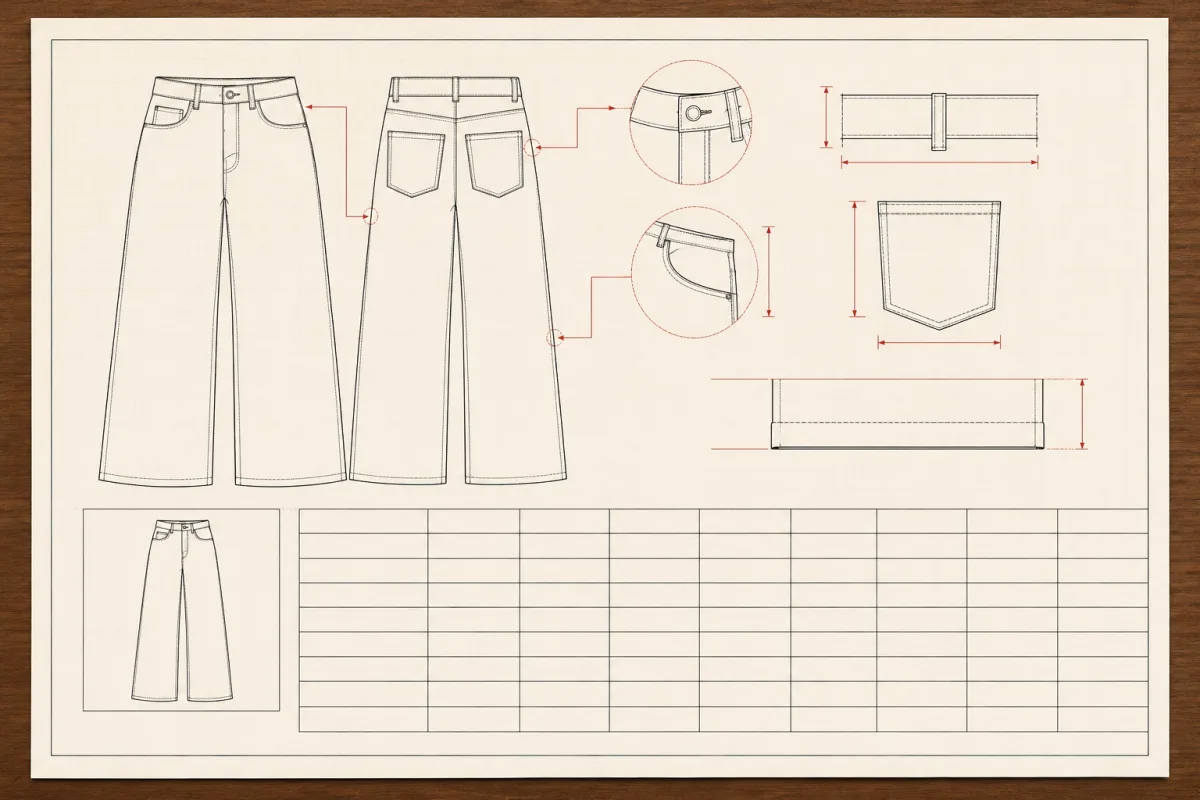
A printed specification sheet seen from above: garment flats, detail circles and an empty measurement table grid.
A tech pack sheet laid out the way a production room expects to read one.
  • A technical flat

    Front and back, drawn to the same scale and aligned, with the construction visible. No shading and no body, because a production room reads outlines, not renders.

  • A measurement table

    Every dimension in centimetres and inches, with a tolerance, and a sentence saying where on the garment it is taken.

  • A point diagram

    The flat again, with each measurement's start point, end point and direction marked, so the sentence has a picture attached to it.

  • A grading table

    How each dimension changes across the size run, stated as increments from the sample size.

  • A fabric note

    Composition, a weight range in g/m², and usable width. A weight range matters more than a fabric name.

  • A trims list

    Buttons by size, count and finish; thread; interlining; labels; anything that has to be bought separately.

  • Construction notes

    Seam types by stitch class, hem finish, topstitch distances, bar tacks — the parts a drawing implies but does not state.

  • Label content

    Composition, origin and care fields, as a template. Not a compliance sign-off — see below.

03Care and composition labels

Field templates, not a compliance sign-off

Labels are a legal requirement in most markets, and the requirements differ and change. We give you the fields; the responsibility stays with you.

  • Provided: The fields usually required in the UK, EU and US, side by side
  • Provided: Fibre composition, country of origin and care instruction slots
  • Provided: A reminder that childrenswear cord and drawstring rules apply
  • Not provided: Any statement that your label is legal where you sell
  • Not provided: A licence to use any care symbol set
  • Not provided: Testing, certification or a declaration of conformity
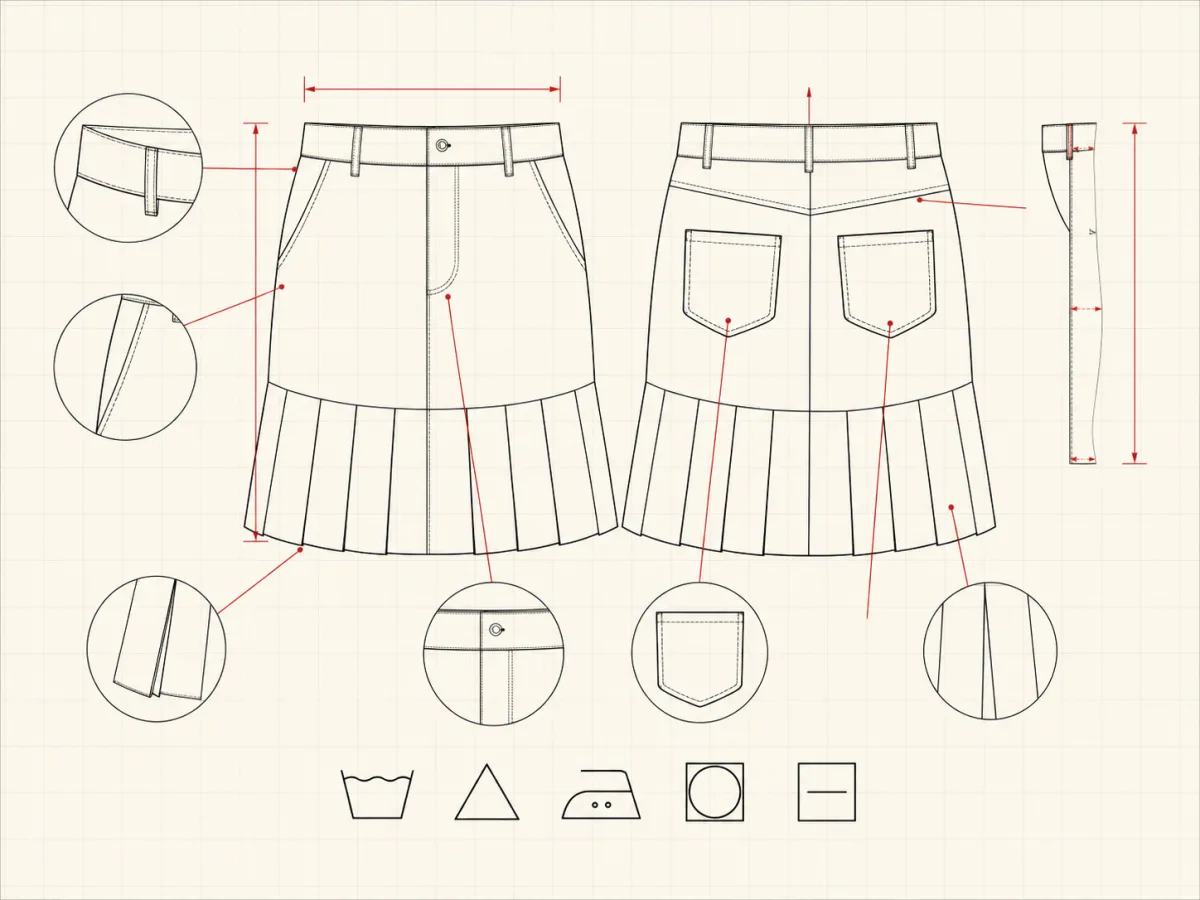
Line drawings of standard textile care symbol outlines: a wash tub, a triangle, an iron, a circle in a square and a bar.
Care symbol shapes are drawn for reference. Whether you are licensed to print a given symbol set in a given market is yours to confirm.

04Prints and artwork

A pattern here ends up on a production run

Which is why the rules on generated artwork are stricter than they would be for an image you look at once. An infringing motif becomes stock that cannot be sold.

  • Prompts containing a brand, house or designer name are blocked outright — there is no 'in the style of' entry point.
  • Trade marks, characters, club crests, real people, flags and state insignia, religious iconography, indigenous patterns and in-copyright artwork are all refused.
  • Generated artwork is recorded as generated, with its parameters kept, so its origin can be evidenced later.
  • Uploading a reference image requires you to confirm you hold the rights, and that confirmation is recorded with the file.

Report an infringement

Tiling print repeat with the repeat unit marked at 90 mm square
Generated repeats are supplied with the repeat unit dimension marked in millimetres and a note on the printing method they suit. Colour is specified as a placeholder reference, not tied to any particular colour system.

05One more time

No track record is being claimed here

ORASCI LIMITED was incorporated on 2026-06-05. You will not find client logos, testimonials, case studies or a count of packs produced on this site, because none of it would be true yet. Judge the output, not the story around it — the free plan exists for that.

Start on the free plan, describe one garment, and read what comes back — particularly the list of questions it says it cannot answer. If that list is useful to you, the paid plans are worth it. If it is not, you have lost nothing.