Step 02Chat
Start from something that already fits
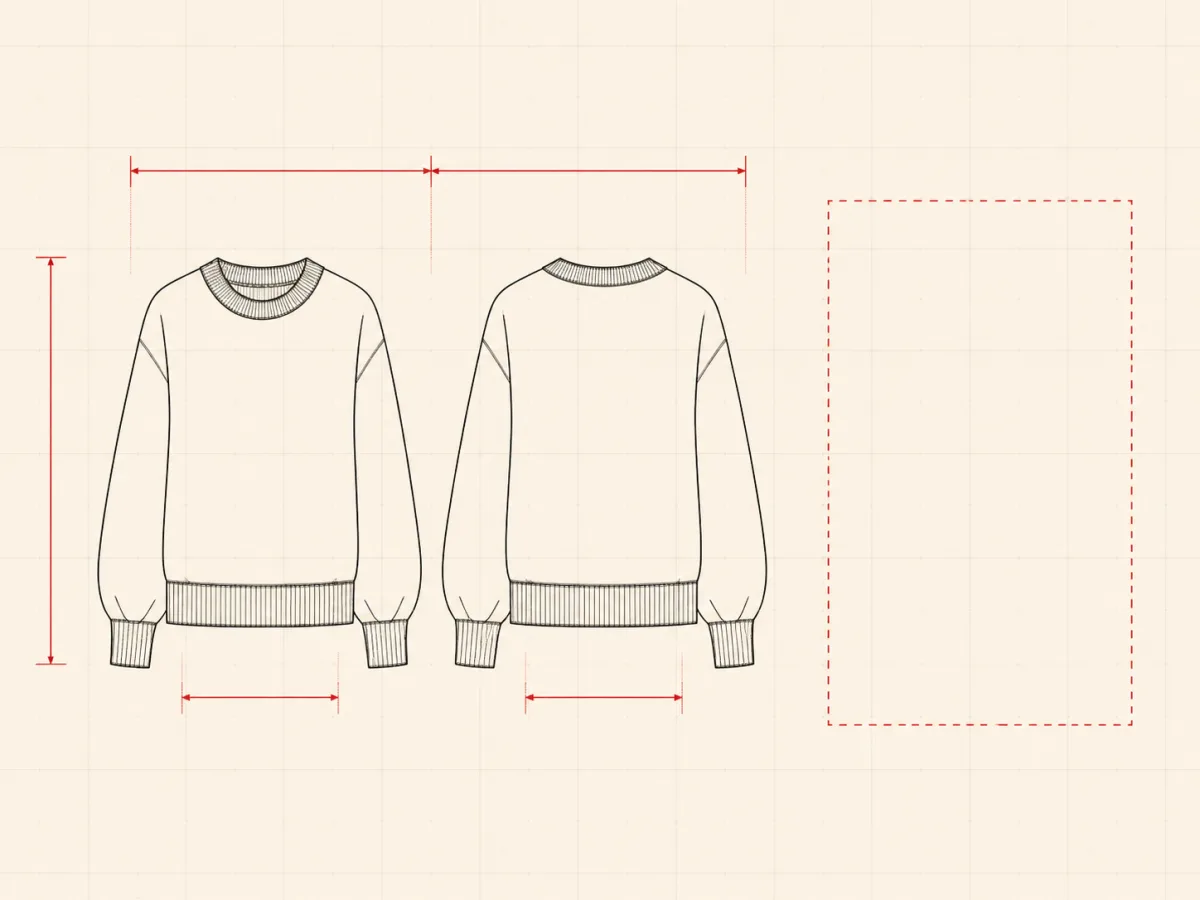
The most reliable brief in clothing is a garment you own and like the fit of. Measure it flat, give us the numbers, and we map them onto the standard points.
Two things come out of this that a list of numbers on its own does not have: the measurements you did not take, and a clear line between what you measured and what we worked out.
I have a shirt I own that fits the way I want. I measured it flat and got these numbers: chest 57, length 71, shoulder 51, sleeve 58. Turn this into a spec I can send, and tell me which measurements I'm missing.
Four numbers is a normal starting point. A factory needs roughly three times that.
01What comes back
Mapped, gapped, and marked
| Field | What it holds |
|---|---|
| mapped[] | Your numbers matched to standard measurement points, with the method sentence attached to each so the next person measures it the same way. |
| missing[] | Standard points you did not measure. Each says whether it can reasonably be derived from what you gave, or whether you need to go back to the garment with a tape. |
| is_inferredNever merged | Set on any value we derived rather than received. It stays set through grading, through the diagrams and into the export. |
| assumptions[] | What we assumed in order to derive anything — for example, that the garment was measured flat rather than around. |
| Measurement | cm | inch | Tolerance | Where it is taken |
|---|---|---|---|---|
| Half chest | 57.0 | 22 1/2 | ± 1.0 | Measured flat, 2.5 cm below the armhole, side seam to side seam. Taken from your measurement. |
| Body length, CB | 71.0 | 28 | ± 1.0 | Measured from the centre back neck seam straight down to the hem edge. Taken from your measurement. |
| Shoulder to shoulder | 51.0 | 20 1/8 | ± 0.6 | Measured across the back, shoulder seam point to shoulder seam point. Taken from your measurement. |
| Sleeve length | 58.0 | 22 7/8 | ± 0.6 | Measured from the shoulder seam point along the top of the sleeve to the cuff edge. Taken from your measurement. |
| Armhole, straightInferred | 26.0 | 10 1/4 | ± 0.5 | Derived from chest and shoulder using a common ratio for this fit. Check it against the garment. |
| Hem sweepInferred | 59.0 | 23 1/4 | ± 1.0 | Derived by assuming a straight side seam below the armhole. If the garment flares, this is wrong. |
| Cuff width | — | — | — | Not derivable. Measure the cuff on the garment, along its edge, buttoned. |
| Collar stand height | — | — | — | Not derivable. Measure at centre back from the neck seam to the top fold. |
| Neck opening | — | — | — | Not derivable. Measure the collar band from buttonhole centre to button centre. |
02Inferred is not measured
Derived values stay visibly separate
A derived number in a spec sheet is a guess with a decimal point on it. It is useful, and it is not the same as something you checked with a tape.
Marked at the point of creation
The moment a value is derived rather than received, it carries the inferred flag. Nothing has to be remembered later.
Marked in the interface
A dashed outline and the word inferred, not colour alone — the distinction survives a black and white printout and a screen reader.
Marked in the export
The PDF carries it too, so the person reading it in a production room sees it without being told.
Cleared by you, not by us
Type a measured value over it and the flag goes. Nothing clears it automatically, and no amount of downstream editing quietly launders it.
What we will not do with your numbers
- Round them to look tidier than they are.
- Convert to inches and discard the centimetre value. Both are kept.
- Fill a gap silently to make the table look complete.
- Tell you which gaps matter most for a quote.