
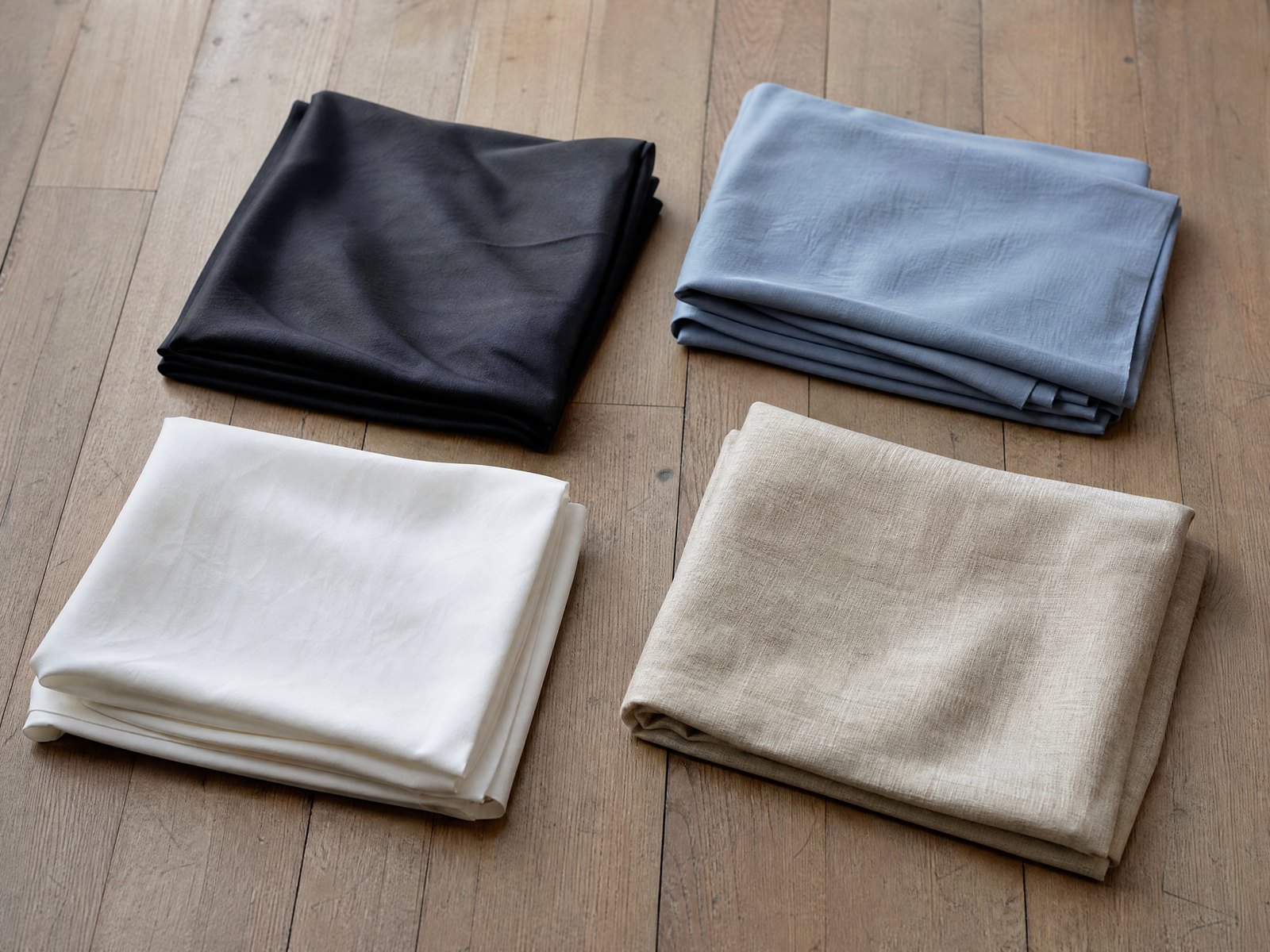
The cloth we use, and why
We choose fabric by what a shape has to do. A shirt dress needs a cloth that holds a collar and a straight placket. A bias slip needs one that falls without any help. A pressed pleat needs a fibre that remembers heat. Below is every fibre on this site, what it gives you and what it costs you, so you can read a product page and know what you are buying rather than guessing from the word on the label.
Viscose
A regenerated cellulose fibre made from wood pulp. It has the softness and cool handle of cotton with far more drape and a quiet matte surface, which is why it carries our column shapes. It takes our soft greys and slate blues deeply and evenly. The trade-off is that viscose loses strength when wet and creases more readily than a synthetic — so wash it gently, never wring it, and expect to press it. It can shrink slightly on a first hot wash, which is why every viscose dress here says 30C.
Cupro
Also cellulose based, spun from cotton linter. It behaves like a fine silk: cool against the skin, fluid, with a soft low sheen that photographs beautifully in daylight. We use it in slip dresses where we want silk’s fall without silk’s fragility or price. It is breathable and does not cling with static. It marks with water spots if you let drips dry on it, and like viscose it is weaker wet, so it is a hand wash cloth.
Cotton poplin
Tightly woven plain-weave cotton with a fine crosswise rib. Crisp, opaque, strong and washable, it is the correct cloth for a shirt dress: it holds a collar stand, keeps a placket flat and presses to a clean line. It breathes well and gets softer with every wash without going limp. It creases in wear, particularly at the elbow and the lap, and it needs an iron to look its best. That is the deal with a real poplin.
Linen and linen cotton blends
Linen comes from flax and is the most breathable fibre we work with, with a dry cool handle and a slight natural irregularity in the yarn that keeps a pale grey from looking flat. It is strong and long-lived. It also creases, immediately and visibly. Blending it with cotton or viscose softens the handle and calms the creasing without losing the breathability, which is why our summer shirt dresses are usually a blend rather than pure linen. If crisp is what you want at 6pm as well as 9am, linen is not the fibre.
Tencel lyocell
A lyocell fibre produced in a closed-loop solvent process, which recovers and reuses the solvent rather than discharging it. Practically, it sits between viscose and cotton: smoother and stronger than viscose, more fluid than cotton, with excellent moisture management and very good colour depth. It resists creasing better than either. Its one habit is that a hot dry iron can burnish it into a faint shine, so we steam rather than press.
Polyester crepe and pleated polyester
We are direct about polyester: it is the only sensible choice for a permanent pleat. Polyester is thermoplastic, so heat sets a knife or sunray pleat into it and the pleat survives years of wear and washing. Nothing natural does that. A good crepe polyester also has a dry, textured, matte hand nothing like cheap shiny lining, holds colour without fading, dries fast and resists creasing everywhere except where we want the crease. The costs are real: it breathes less than cellulose fibres, it can hold odour, it builds static in dry air, and it is a petrochemical fibre that sheds microfibres in the wash. A mesh bag and a full load reduce that shedding. We use polyester where its properties genuinely serve the garment, and cellulose fibres everywhere else.
Georgette
A light, sheer, crinkle-surfaced fabric woven from tightly twisted yarns. It has a dry grainy handle and a floating drape, which is why it works for evening layers and sleeves. It is sheer by nature, so we line it. It snags on rough jewellery and rings, and it moves under a needle, which makes it slow to sew well.
Scuba crepe
A double-knit polyester with elastane, smooth-faced with a slight body to it. It holds a body-skimming shape without needing a lining and it recovers rather than bagging at the knee or the seat. It is warmer than a woven and less breathable, so it suits cooler months and evenings rather than a hot day.
Elastane
Never used alone, always 3 to 12 per cent alongside a main fibre, to add recovery to a close shape. It is what stops a pencil dress stretching out of shape by the afternoon. Heat is its enemy: hot washes, tumble dryers and a hot iron all break it down and are the usual reason a stretch dress goes slack. Wash cool, dry flat or on a hanger, keep the iron away from stretch seams.
Linings, threads and trims
Linings are polyester taffeta or polyester crepe on evening pieces, chosen because they are smooth, stable and washable, and they are named in full in the fibre content on every product page. Threads are polyester core for strength at the seam. Zips are metal-free nylon coil in an invisible finish, set into a taped seam so they run straight. Buttons are matte resin in tones drawn from the same pearl and slate palette. Where a dress has any component we have not listed, the product page names it.
Questions about a specific cloth
If you need to know how a particular fabric behaves before you order — how sheer it is, how warm, how it takes a press — write to support@orasci.shop and we will tell you honestly, including when a fabric is the wrong choice for what you have in mind. Full fibre content for every dress is on its product page at https://orasci.shop.
ORASCI LIMITED
Company number 17264390, registered in England and Wales.
Registered office: 106 Warren Road, Orpington, BR6 6JA, England
Email: support@orasci.shop
ORASCI LIMITED is not currently registered for VAT. No VAT is charged on the prices shown on this website.